Research from the Melnick lab on African ancestry lymphoma reaches the ASH Scientific Plenary Session
A collaborative study led by Dr Ari Melnick, Director of the Josep Carreras Leukaemia Research Institute, has been selected for the prestigious Plenary Scientific Session at the 2025 American Society of Hematology (ASH) Annual Meeting. Only six abstracts were chosen from more than 8,000 submissions. The research, presented by Dr Sanket Shah, postdoctoral fellow at Weill Cornell Medicine, linked mutations in SETD2 with an aggressive form of diffuse large B-cell lymphoma in people of African-ancestry.
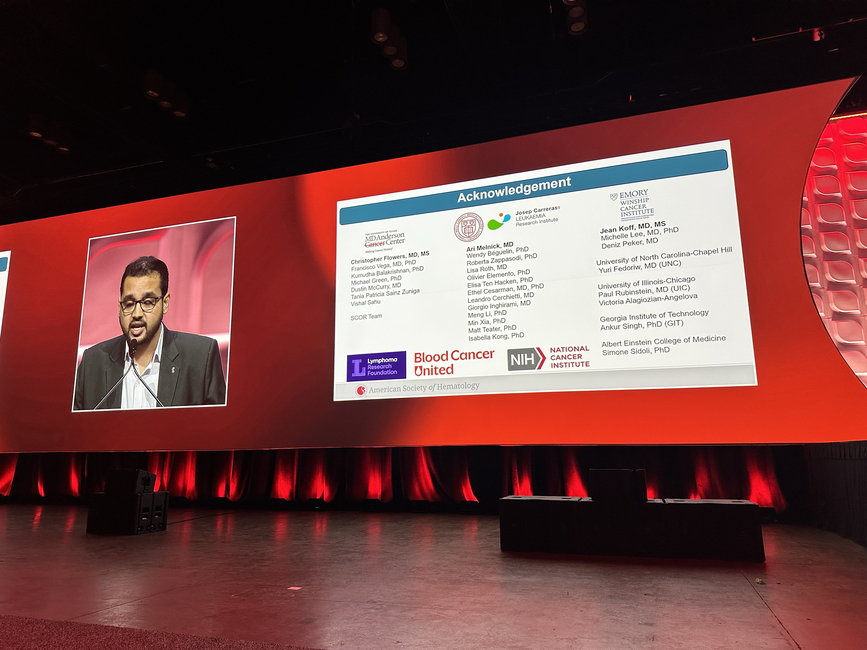
Researchers from the Josep Carreras Leukaemia Research Institute, in collaboration with partners at Weill Cornell Medicine, MD Anderson Cancer Center, and Emory University, unveiled transformative new findings at the 2025 American Society of Hematology (ASH) Annual Meeting. The work, led by postdoctoral researcher Dr. Sanket Shah, was selected for presentation in the prestigious ASH Plenary Session, an honor reserved for only six abstracts chosen from more than 8,000 submissions worldwide.
The study identifies a previously unrecognized subtype of diffuse large B-cell lymphoma (DLBCL) that occurs almost exclusively in individuals of African ancestry. This form of lymphoma appears to behave differently from other types of DLBCL and is driven by a unique biological program that allows cancer cells to* hide from and disable the immune system*.
A New Biological Explanation for Health Disparities in Lymphoma
DLBCL is the most common type of aggressive lymphoma. In the United States and globally, individuals of African ancestry are diagnosed at younger ages and often experience poorer outcomes. Until now, the biological reasons behind these disparities have remained largely unknown.
Dr. Shah and colleagues discovered that many tumors arising in African ancestry patients carry a mutation in the SETD2 gene, which impairs the cell’s ability to repair DNA damage. This genetic instability triggers a cellular response known as senescence—a stressed, inflammatory state in which tumor cells begin releasing large quantities of immune-altering molecules. This “SASP” (senescence-associated secretory phenotype) effectively exhausts and disables CD4 and CD8 T cells, the immune system’s frontline defenders.
“Instead of slowing down the cancer, this inflammatory response gives the lymphoma a way to hide in plain sight,” said Dr. Ari Melnick, senior author and Director of the Josep Carreras Institute. “This discovery helps explain why these lymphomas behave so aggressively and why current treatments often fall short.”
A New Path to Precision Immunotherapy
Importantly, the team found that this ancestry-linked lymphoma subtype may be highly responsive to therapies that do not typically work in DLBCL. In laboratory models, tumors with this SASP-driven biology were remarkably sensitive to immune checkpoint inhibitors, a class of drugs that reinvigorate exhausted T cells. They also responded to a new investigational drug that targets the SETD2 mutation itself, restoring normal immune function.
“These findings open the door to developing ancestry-informed precision treatments*,” said Dr. Sanket Shah, the post-doctoral fellow who performed much of this research. “This is a major step toward reducing long-standing inequities in lymphoma care.”
Dr. Melnick added: “We are extremely proud to see this work recognized on the plenary stage. It highlights the power of deeply collaborative science focused on underserved populations.”
A Commitment to Addressing Cancer Disparities
This plenary presentation reflects a broader initiative within the Melnick Lab and its collaborators to uncover how ancestry, sex, and genetic background influence lymphoma biology. Work presented at the same ASH meeting by Dr. Benedikt Pelzer revealed a distinct mechanism driving more severe lymphoma outcomes in females compared to males—further underscoring the importance of studying cancer through the lens of biological diversity.
“As a research community, we have a responsibility to understand why certain populations face worse outcomes,” said Dr. Melnick. “By identifying the unique biology behind these disparities, we can finally begin designing treatments that work for everyone.”