The Josep Carreras Institute strengthens its international presence at EHA 2026
The Josep Carreras Leukaemia Research Institute played a prominent role at the 2026 Congress of the European Hematology Association, held in Stockholm from 11 to 14 June. Researchers from the Institute presented their latest findings, chaired scientific sessions and took part in activities that reinforced IJC's international leadership in blood cancer research. The congress also provided an opportunity to strengthen ties with the Karolinska Institute through a joint scientific workshop.
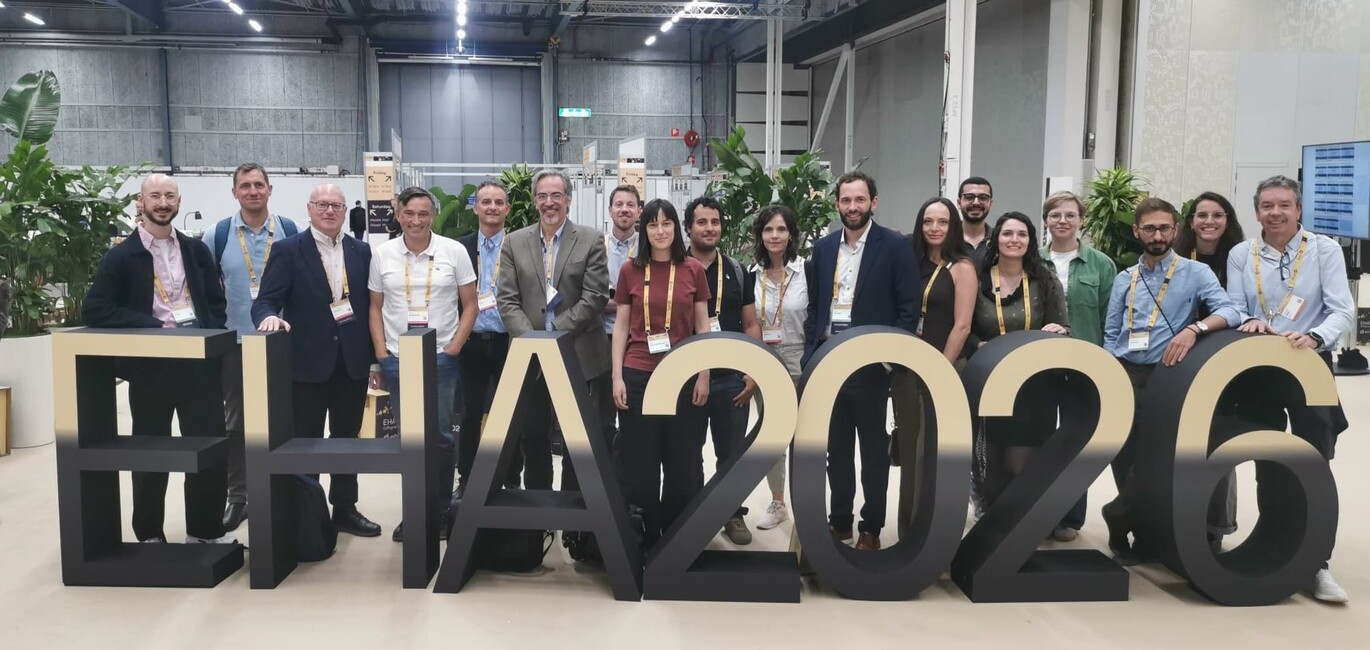
As one of the world's leading scientific meetings in haematology, the 2026 Congress of the European Hematology Association (EHA) brought together more than 18,000 clinicians, researchers, patient advocates and industry representatives from around the world, including around 15,000 attending in person, to discuss the latest advances in blood disorders and blood cancer research. The Josep Carreras Leukaemia Research Institute (IJC) had a strong presence throughout the congress, contributing to the scientific programme and strengthening international collaborations.
The EHA congress recognised several IJC researchers. Dr Josep Maria Ribera received the EHA Clinical Excellence Award, one of the association's highest distinctions, in recognition of his outstanding scientific and clinical contributions to the clinical haematology, especially in acute lymphoblastic leukaemia (ALL). Reflecting on the award, Dr Ribera emphasised the importance of collaboration throughout his career: “This recognition is shared with a number of outstanding professionals with whom I have had the privilege of collaborating over the years. This recognition belongs to them as well.”
Two IJC postdoctoral researchers had the opportunity to present their work, David Corujo and Gerard Martínez, who were also selected as scholars of the EHA-EMBL/EBI Computational Biology Training in Hematology (CBTH) programme.
Dr David Corujo, from Dr Marcus Buschbeck’s lab, presented research carried out in collaboration with the team of Florian Heidel at Hannover Medical School.
“Acute myeloid leukaemia (AML) is dominated by blasts but contains a subpopulation of leukemic stem cells (LSCs) in the bone marrow with a high capacity to self-renew, are highly resistant to chemotherapy and are the most common cause of patient relapse after treatment. We have identified that depleting the histone variant protein macroH2A1 greatly diminishes the self-renewal capacity of LSCs in AML while being dispensable for normal haematopoiesis. This means that macroH2A1 is a novel leukaemia-specific vulnerability that could be a therapeutic target to specifically attack the LSC population in AML.”
David Corujo, IJC postdoctoral researcher.
Dr Gerard Martínez, from Dr Sergi Cuartero’s lab, presented his research on paediatric myeloid leukaemia associated with Down syndrome:
“My research on paediatric myeloid leukaemia associated with Down syndrome dissects the epigenetic mechanisms that contribute to leukemic transformation and disease development. These insights also open the door to new therapeutic approaches that we are currently exploring.”
Gerard Martínez, IJC postdoctoral researcher.
The scientific programme also featured a spotlight lecture by Prof Ari Melnick, Director of the Josep Carreras Leukaemia Research Institute, entitled “Malignant evolution of the immune system”, in which he explored the role of the immune system in lymphoma. Dr Álvaro Urbano-Ispizua also contributed as a speaker in a Specialised Working Group Session on immune therapies for haematologic disorders, where he gave a presentation on point-of-care production.
The Institute's contribution to EHA 2026 also included 13 accepted abstracts, six of which were presented as posters during the congress. Together, the abstracts covered topics including ALL, AML, Hematopoiesis, stem cells and microenvironment, gene therapy and cellular immunotherapy or Lymphoma biology. The posters presented were:
Júlia Aguadé-Gorgorió: “Investigating the maintenance of self-renewal programs by AML leukemic stem cells.”
Adela Cisneros: “1Q gains detected by optical genome mapping (OGM) are more predictive of prognosis than those detected by FISH in newly diagnosed multiple myeloma.”
Klaudyna Fidyt: “SCFV-based anti-CD72 immunotherapy as a potential treatment for B-cell malignancies.”
Gianfranco Lapietra: “Impact of HIV status on clinical features and outcomes of HHV8-associated multicentric Castleman disease: insights from a nationwide GELTAMO study.”
Carlos Quero-Dotor: “Epigenetic regulation of CD52 influences the expression of AKT and modulates the cellular response to venetoclax and uprosertib in acute myeloid leukemia.”
Idoia Vázquez: “Combination of optical genome mapping (OGM) and RNA sequencing refines classification of adult T-cell acute lymphoblastic leukemia (T-ALL).”
Several IJC researchers also chaired scientific sessions during the congress. René Winkler, Pablo Menéndez and Marcus Buschbeck chaired sessions on the bone marrow niche, alternative experimental models, epigenetics and therapeutic advances.
EHA 2026 also included a poster presentation from OneChain Immunotherapeutics, a spin-off of the Josep Carreras Leukaemia Research Institute, with new preliminary interim data on OC-1, its CAR-T cell therapy for patients with relapsed or refractory T-cell acute lymphoblastic leukaemia/lymphoma (T-ALL/T-LL). According to the data presented, the two lowest dose levels evaluated to date showed a good safety profile, consistent with that observed with CAR-T cell therapies. Many of the evaluable patients responded to treatment, and some of them achieved a complete response. The results are preliminary, and recruitment for the two remaining dose levels in the trial is ongoing.
Ahead of the congress, the IJC also took the opportunity to strengthen its international collaborations. On 10 June, *around 30 researchers from the IJC and the Karolinska Institute met in Stockholm to discuss their recent advances in blood cancer research and explore opportunities for collaboration. The workshop, co-organised by Marcus Buschbeck, Pedro Moura and Lucas Pontel, provided a valuable forum to exchange ideas and identify areas of common interest between the two institutions.
Beyond the scientific sessions, EHA 2026 provided an important platform for meetings between collaborators, clinicians, patient advocates, industry representatives and researchers, reinforcing the exchange of knowledge and ideas that drives progress in haematology.